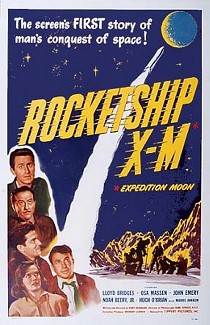
The basic idea here is that the first manned mission to the moon ends up wildly off course and heading towards Mars instead. Upon reaching Mars the crew decide the opportunity to explore the red planet is one that shouldn't be missed and so they decide to land. The crew here consists of four men and one woman. One of the male actors in this looked very familiar to me. Then it suddenly dawned on me... it's Lloyd Bridges. The name may not be familiar to you, but I'm sure the face will, as Lloyd went on to play the "Looks like I picked the wrong week to quit..." guy in the Airplane movies. Anyway, in this film he plays the pilot of the titular rocketship. There's also an older doctor guy who conceived the rocket, his attractive, young female assistant who is a mathematics nerd, another guy who is the navigator, and a fourth guy whose role I can't remember, but he dies anyway (spoiler).
The film starts with a press conference pre-flight where it's announced that this particular rocket is heading for the moon. The press conference is where we are first introduced to the crew. Where it veers a little from reality here is that the press conference takes place approximately 15 minutes before the launch. In reality of course the crew would've long since boarded the rocket. Also the crew are all wearing leather bomber jackets and look more like WW2 pilots than astronauts. But these things can be forgiven when you consider what they actually got right. The doctor guy then explains the rocket and the journey to the press. He talks about trajectories, orbits, gravity and all good sciency type shit. Fairly impressive stuff. He also describes the rocket, which is built from several stages (again good). The only bit that this film (and every other film of the time) gets wrong is that the rocket reverses down to the surface and uses its engines to land, both when landing on the moon and back on earth. In reality you of course have a separate lander for the moon and your capsule lands back on earth via parachute. But again, for the time it's pretty impressive.
After the press conference the crew climbs aboard the rocket. The rocket's crew module is quite impressive too. Well, at least it looks as if they're inside a cylindrical rocket and not just sat in a room. Plus they enter they module from a sealed hatch in the floor, climbing up a ladder through the lower stage, which has several fuel tanks within it. Again, not too bad really.
 So the rocket blasts off and they all make comical faces to presumably show that they're being affected by the g-forces. Lisa, the female of the crew, looks like she's having some sort of "crisis". The external shot of the rocket taking off looks excellent and very realistic. The reason for this is that the film used footage of a V-2 rocket taking off. Still, it works for me. And I'd rather they do that than use some naff looking special effect instead. Once they're in orbit the shots of the earth out of the window look pretty good too. They also attempt to show weightlessness too, as one of the crew's jackets drifts upwards from its place upon the back of a chair. Also the straps to their bunks start floating upwards too. Apparently lighter objects can be weightless, but a human is too heavy to float. Still, have to give them credit again for the effort.
 Once on their way to the moon, they are soon left powerless and adrift. Upon checking the engines and discovering that they're fine, the doctor guy concludes that the fuel mixture must be wrong. Lisa and the doctor guy then attempt to discover what's wrong by doing some equations and stuff. The doctor guy and Lisa come up with different results. The doctor guy proclaims that Lisa has made an error and that his calculations are correct. At this point they can only continue using one of their sets of calculations because to continue using both would take too much time. The doctor guy insists they use his calculations. Lisa has an emotional outburst and protests, but then immediately apologises. The doctor guy then forgives her for "momentarily being a woman". Yes, 1950s sexism is in full force in this film.
Once the calculations are made and they have the corrected fuel mixture, two of the guys head below to the engine compartment to make the adjustments (cue floating spanners). The adjustments are made and the guys head back to the crew module. Upon restarting the engines they accelerate way too quickly and everyone is rendered unconscious while the speed continues to climb. The pilot guy manages to kill the engines before he blacks out, but by that time they're already travelling way too fast with nothing much to stop them.
When they all come to the doctor guy proclaims that they've all been out of it for days. Quite how he knows this without checking a watch or a calendar I don't know. Actually no one thinks to do this, as Lisa says that they'll "never know" exactly how long they've been out for. I thought knowing the date and time was pretty important when it comes to navigating in space, but apparently not. The doctor guy looks out of the window and... holy shit there's Mars. So they unanimously decide that they must attempt a landing and explore. At this point I should point out that they would have to have been unconscious for several months, not several days to arrive at Mars, but then I'm sure you all knew that already.
So they successfully land on the surface of Mars. The doctor guy says they won't need their pressure suits because Mars has an atmosphere. The fact that it's 100 times thinner than that of the earth, 95 percent carbon dioxide and bloody freezing doesn't seem to matter much. But then they barely knew anything about the moon in 1950, let alone Mars. But when they do venture out onto the surface it's good to see that they are at least wearing breathing apparatus.
The film does something quite clever for the scenes on the surface of Mars, namely it uses a sepia tone film. This comes as quite a surprise after watching in black and white up to this point, and I have to say it's pretty effective. They discover a relic on the surface which indicates an extremely intelligent race once lived on Mars. But they also discover that Mars is highly radioactive and that this civilisation was destroyed, presumably by nuclear weapons. The doctor says something about intelligence always leading to self destruction (I think you can see where this is going now).
They decide to get some rest in a cave. One of the guys who can't sleep spots some people coming towards them and alerts the others. The people run off before any of the others see them, but our friends see their tracks in the martian surface so they decide to follow. They end up walking through a ravine (never a good idea) and they see people in loin cloths carrying spears above them. The doctor makes another comment "Atomic age to stone age" and as he does so, a boulder is pushed from above and comes crashing down towards them. The guy whose role I can't remember who dies pushes the doctor out of the way, and dies. The doctor expires soon after following a sharp implement to the back, but just before he does he tells the remaining three that it's imperative they get back to earth and tell everyone what they have found. The navigation guy gets hit by a rock. He's in a bad way, but Lisa and the pilot guy manage to drag him back to the rocket.
Once on board the ship Lisa calculates that they still have enough fuel to take off, travel back to earth and make a successful landing. That's pretty impressive considering they were going to the moon, but whatever. So they take off from Mars and head back to earth. With the navigation guy out of it this leaves time for Lisa and the pilot to have the rather inevitable falling in love scene (cue the awful, wispy violin music).
As they come closer to the earth Lisa prepares to fire up the engines for re-entry and landing, but oops... there's no fuel. Sadly she's miscalculated again. Silly 1950's girl, maybe in the future she'll learn to stick to womaning. She admits her mistake to the pilot guy. Lisa is saddened that the earth will never know the terrible truth that they learned. But then they realise that they should be able to contact mission control via radio. So they establish contact and relay all the information gathered from their trip. There then follows some more appalling "Hold me. Hold me tight" soppy dialogue before the rocket plummets to the earth and Lisa and the pilot guy are killed. Aww. The press then talk to the press guy at mission control. The press say that the mission was a failure but the press guy insists that it wasn't because of what they have learned. So much so that he insists that tomorrow they will begin construction of Rocketship X-M2. The end.
I have to say I actually enjoyed this quite a bit. It was nowhere near as naff as I thought it would be. Scientifically speaking there were a few misses, but the principles on the whole were pretty sound. This film undoubtedly carries a strong message about the dangers of an atomic civilisation and a nuclear arms race, especially relevant considering when this was made. And a film made in 1950 where the heroes die in the end? No happy ending? That must be pretty rare, and I commend this film for being brave enough to do it.
The big problem with this film of course is the rather stereotypical and sexist attitude towards the woman. In the pre-flight press conference a woman journalist asks Lisa "Is there any specific reason why one member of the crew should be a woman?". And before Lisa has time to answer the doctor answers for her, as if she's incapable of answering that particular question herself. Later in the film when Lisa and the pilot guy are talking Lisa says "I suppose you think that women should only cook and sew and bear children?" to which the pilot guy responds "Isn't that enough?" quickly followed by "There is such a thing as going overboard in the other direction too you know". So this film probably didn't do much to further equal opportunities for women. But then it is a film of its time, and I don't think many films of the time did that. That was still to come. So if you can looks past its scientific shortcomings and considerably old fashioned views towards women, this isn't actually a bad little film. And it's got that guy from Airplane in it, which can't be bad.

No comments:
Post a Comment